
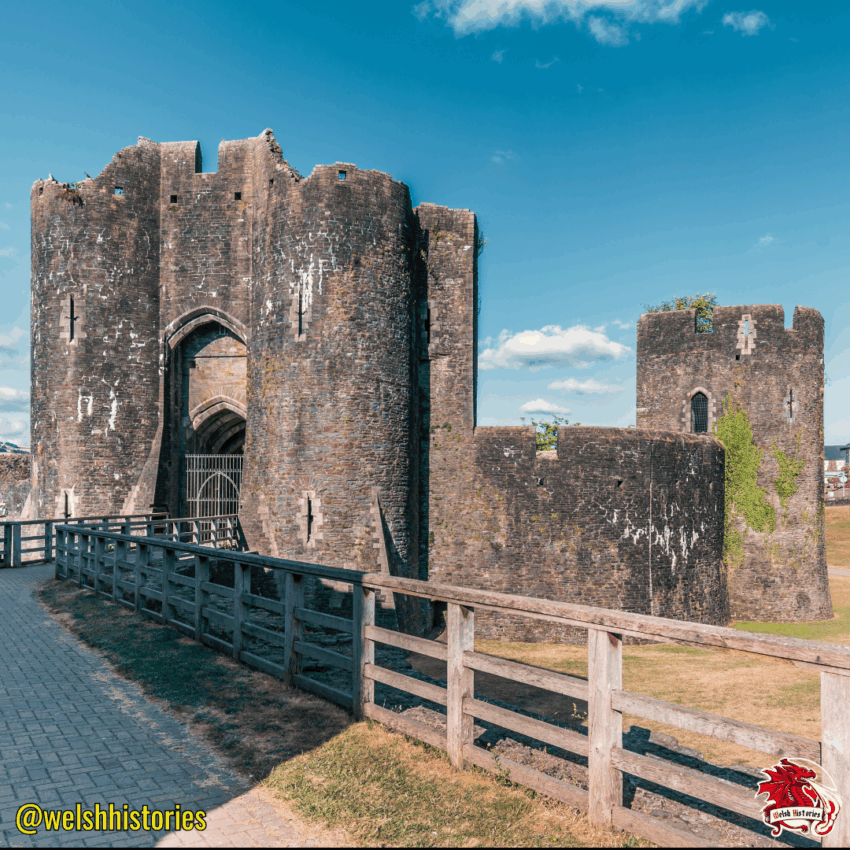
Caerphilly Castle (spelled “Caerffili” in Welsh) is a large, non-native castle situated in Caerphilly, south Wales. In fact, Caerphilly is the largest castle in the entire country and the second largest throughout the entirety of Britain – so it’s pretty big!
What is Caerphilly Castle?
This particular castle dates to the second half of the 13th century. This was, of course, a chaotic period in Welsh history, with much of the south of the country having already been conquered by the Anglo-Normans and the north of the country increasingly under threat.
Caerphilly Castle was built by the Anglo-Norman noble, Gilbert de Clare (1243-1295), who was the Lord of Glamorgan. This title was a powerful, prestigious and extremely wealthy Welsh Marcher title.
De Clare was a rival of the last Prince of Wales, Llywelyn ap Gruffydd (Llywelyn the Last, 1223-1282) whom he believed was threatening his rule in Glamorgan. It was actually a conflict between the two which led to Gilbert building Caerphilly Castle in an attempt to cement his power within the region, fearing an attack from the native Welsh forces.
De Clare was able to take control of the area (in spite of efforts by Llywelyn and King Henry III of England to come to an agreement), weakening Llywelyn in south Wales. By 1277, Llywelyn was in conflict with Edward I and by 1282, he was dead and Welsh independence with it. Gilbert had succeeded in strengthening his position, though its limits would tested during the Madog Rebellion in 1294. Half of the town would be burned down but the castle would stand firm.
The death of Gilbert de Clare in 1295 would see the castle passed down to his son, also named Gilbert. He would perish at the Battle of Bannockburn in 1314, leaving the castle with no living claimant. Llywelyn Bren (1267-1317), the next Welsh rebel, would rise up in 1316 – leading, once more, to the destruction of Caerphilly town. However, again, the castle stood firm and would not fall into Welsh hands.
The castle would finally be captured by Welsh forces during the Glyndŵr Rising (1400-1415), led by Owain Glyndŵr (1354-1415). The Uprising would ultimately not be successful and the castle would return to English nobility through Isabel le Despenser and her second husband, Richard Beauchamp.
The castle would enter a period of significant decline in the latter part of the 16th century and by the end of the English Civil War (1642-1651), the castle was slighted (most likely by the Parliamentarians) to prevent further military use.
By the 18th and 19th centuries, the castle had become a certified ruin – though one of significant romanticist interest. Some restoration work took place in the early 20th century and by 1950, the castle was handed over to the state. It is today overseen by Cadw and remains a popular tourist (and wedding) attraction.
More from Welsh Histories
Welsh Histories is a Welsh history celebrating platform which looks to promote all aspects of Welsh history. Though we focus predominantly on native Welsh history, we do also share the non-native aspects from time to time. You can follow us on Facebook; Instagram or Twitter for more. A reader? We also have our very own Welsh Histories Shop where we sell our Welsh Histories Magazine. Diolch yn fawr iawn and keep enjoying Welsh Histories.
Welsh Histories Magazine – 13 Issue Special Offer
Welsh Histories Magazine – 12 Issue Special Offer
Ever wanted to own our first 13 digital issues of Welsh Histories Magazine for a meagre price? You have come to the right place!
For just £9.99, this purchase grants you access to our first 12 digital issues of Welsh Histories Magazine – from our very first issue in March ’24 to our latest issue from March ’25. This amazing deal allows you to walk through the history of Welsh Histories Magazine and observe how the magazines have evolved over time and, more importantly, get in on all of the Welsh history topics within.
Given that the price of the latest magazine currently stands at £3.99 and the majority of the others stand at £1.99, this deal saves you more than £10! You’re saving 50%!
Get it while you can as this deal won’t be on here for long.
Happy reading!
If you have any issues with receiving and downloading your copy, please send all queries to: niklas@welshhistories.co.uk.
More from Welsh Histories
Welsh Histories is a Welsh history celebrating platform which looks to promote all aspects of Welsh history. Though we focus predominantly on native Welsh history, we do also share the non-native aspects from time to time. You can follow us on Facebook; Instagram or Twitter for more. A reader? We also have our very own Welsh Histories Shop where we sell our Welsh Histories Magazine. Diolch yn fawr iawn and keep enjoying Welsh Histories.

Niklas is the founder, owner, manager, editor, writer, video creator, voice over artist, and so forth, of Welsh Histories. He is passionate about the preservation of Welsh culture; the rejuvenation of the Welsh language and the promotion of Welsh history. Niklas currently resides in Pune, Maharashtra, with his beloved wife.