
I have written about plenty of the castles which surround Abertawe (Swansea) in recent times (such as Oystermouth and Kidwelly) but I don’t believe I have ever written about Swansea Castle.
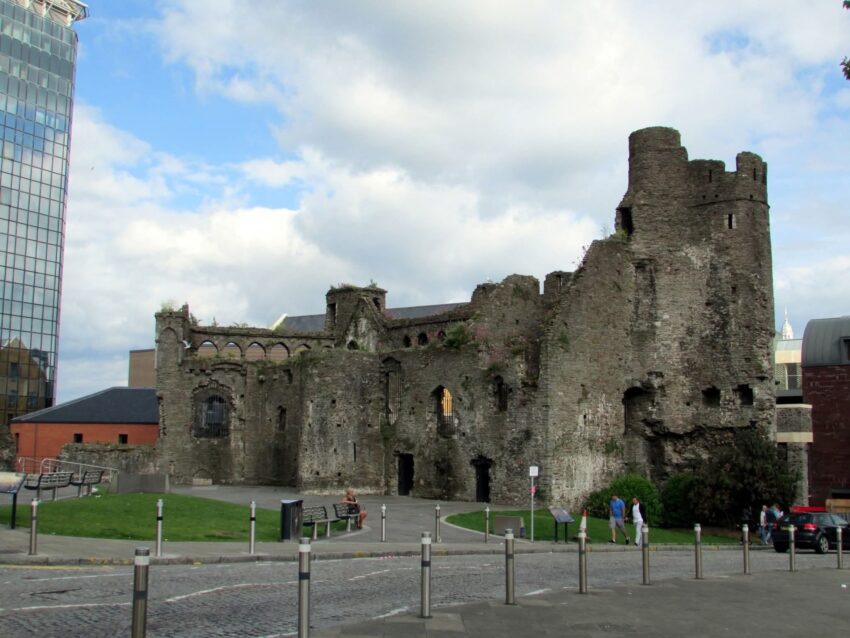
Swansea Castle is a Norman-built castle which lies in the city center of Abertawe. It is entirely ruinous with just two blocks remaining. However, it remains a marvel in the De Cymru city and beautifully blends the medieval with the present.
Originally around 1107, the castle was constructed from timber (as were most Norman castles of the time, Chepstow being the notable exception) and stood next to Afon Tawe, when it once flowed in this part of the city.
It would be besieged by the native Welsh forces a plenty throughout the century, most notably in the year of 1192 when it fell to the famed Welsh King of Deheubarth, Rhys ap Gruffydd. The Norman-English would reclaim it shortly after, however, though it would fall into Gwynedd hands in 1217 when Llywelyn Fawr (Llywelyn the Great) next took the castle. It would be restored to the Norman-English once more in 1220, when Llywelyn and Henry III made peace.
Following these events, it was decided that the castle would be fortified in stone sometime between 1221 and 1284 – a smart, if unnecessary decision. Even when the Uprising of Owain Glyndŵr came between 1400 and 1415, it is believed he never attempted to capture the castle. Its strategic position and significance had been on the wane for some time and, perhaps, Glyndŵr saw it being of little value.
The castle would enter a period of decline and be classed as “decayed” by the mid 17th century. The river, Afon Tawe, would be diverted away from the castle in the 1840s – by which time Swansea Castle was little more than a glorified ruin.
It is know, however, that the famed Welsh poet Dylan Thomas worked for the South Wales Daily Post at the site in the 1930s. A final semblance of relevance.
(Image Credits: Reading Tom @ Flickr)
More from Welsh Histories
Welsh Histories is a Welsh history celebrating platform which looks to promote all aspects of Welsh history. Though we focus predominantly on native Welsh history, we do also share the non-native aspects from time to time. You can follow us on Facebook; Instagram or Twitter for more. You can also support us as a member of our Patreon community. A reader? We also have our very own Welsh Histories Shop where we sell our Welsh Histories Magazine. Diolch yn fawr iawn and keep enjoying Welsh Histories.

DIGITAL Welsh Histories Magazine – January 2026

Niklas is the founder, owner, manager, editor, writer, video creator, voice over artist, and so forth, of Welsh Histories. He is passionate about the preservation of Welsh culture; the rejuvenation of the Welsh language and the promotion of Welsh history. Niklas currently resides in Pune, Maharashtra, with his beloved wife.