
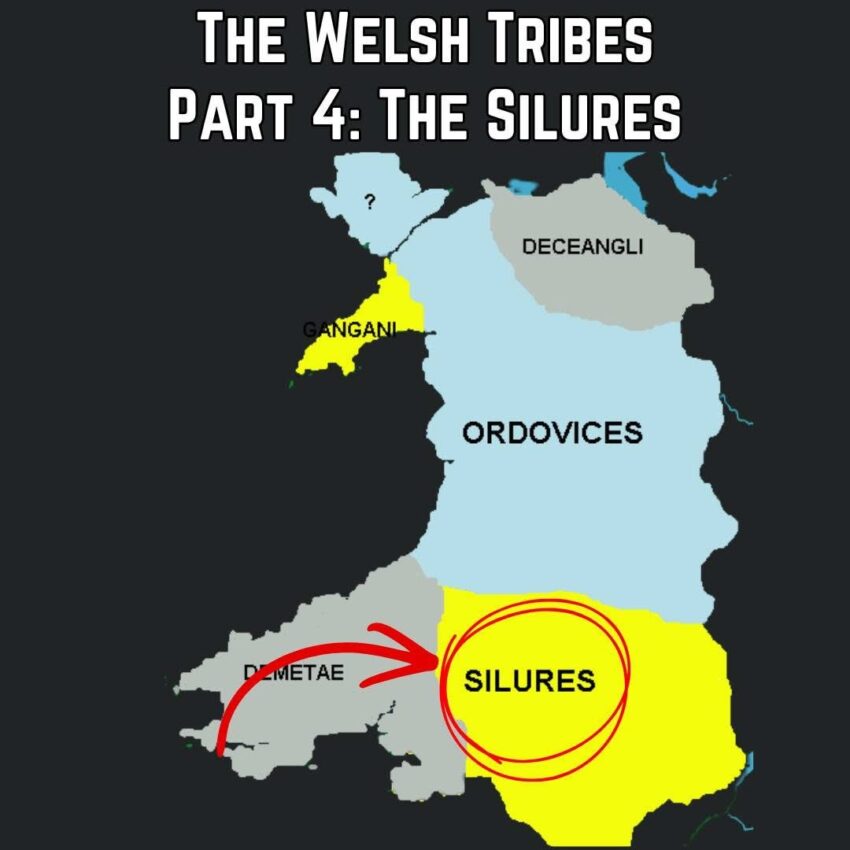
Welcome back to the series on the ancient tribes of Cymru. So far, I have covered each of the Deceangli, Gangani and Ordovices in separate posts. We now move on to the southeast of the country and arrive with my arguable favourite: the Silures.
Who Were the Silures?
The Roman historian, Tacitus, believed the Silures were non-native to the island of Britain. He felt this to be the case because, unlike some (but not all) of the other tribes of Britain, the Silures were of a darker complexion and usually with dark, curly hair. As a Welshman with a slightly darker complexion and curly hair, I can relate to the constant accusation that I, too, am non-native.
Tacitus wrote of them: “the dark complexion of the Silures, their usually curly hair, and the fact that Spain is the opposite shore to them, are an evidence that Iberians of a former date crossed over and occupied these parts.”
So, Tacitus believed that the Silures were of Iberian origin. Who are we to argue with him?
There is a little bit of a debate on the etymological origins of the term “Silures”. Though a Latin word, it is believed to have Celtic roots, coming from the Common Celtic root “sīlo”, meaning “root”. It is believed that, in this context, it refers more so to ancestral roots than plant-like roots and therefore likely refers to some kind of Silurian belief in the importance of ancestry. Like the other tribes covered so far, the Silures lived in large hillforts, such as Bryngaer Caerau (Caerau Hillfort).
The Silures were part of a mighty Brythonic resistance against the Roman Conquest of Britain. Joining forces with the Ordovices, under the leadership of the great ancient Briton warlord, Caradog (known in English as Caratacus, the King of the Britons), it took years – if not decades – before the Silures were finally subdued by the might of Rome. The Silures also carried on resisting Rome even after the fall of Caradog in AD 51, resorting to guerilla warfare like campaigns which led to them becoming so threatening to Rome’s ambitions that the eventual plan of Roman generals was to exterminate the Silures instead of conquering them.
However, Tacitus also writes that the Silures were changed “neither by cruelty nor by clemency”, indicating that they were likely subdued sometime in AD 78, rather than exterminated. By AD 78, much of Celtic Britain had fallen and, perhaps, the Silures saw they were fighting a losing battle. We don’t know what truly happened to them, though one thing is certain: they were a massive pain in Rome’s backside.
Although likely and eventually subdued by Rome, the Silures did not fully go away. On the contrary, there is evidence that they held onto some of their Silurian folklore and traditions. An example of this exists in Kings of the various kingdoms in southeast Wales, such as the Kingdom of Gwent, naming their heirs “Caradog” or variations of the name. The Kingdom of Gwent, for example, was founded by a Caradog.
More from Welsh Histories
Welsh Histories is a Welsh history celebrating platform which looks to promote all aspects of Welsh history. Though we focus predominantly on native Welsh history, we do also share the non-native aspects from time to time. You can follow us on Facebook; Instagram or Twitter for more. You can also support us as a member of our Patreon community. A reader? We also have our very own Welsh Histories Shop where we sell our Welsh Histories Magazine. Diolch yn fawr iawn and keep enjoying Welsh Histories.
Top rated products
-
DIGITAL Welsh Histories Magazine – November 2025
Original price was: £3.99.£1.99Current price is: £1.99. -

PHYSICAL COPY Welsh Histories Magazine – April 2025
£5.99 -
DIGITAL COPY Welsh Histories Magazine – April 2025
Original price was: £2.99.£1.99Current price is: £1.99. -
DIGITAL COPY Welsh Histories Magazine – May 2025
Original price was: £3.99.£1.99Current price is: £1.99. -

PHYSICAL COPY Welsh Histories Magazine – May 2025
£5.99


Niklas is the founder, owner, manager, editor, writer, video creator, voice over artist, and so forth, of Welsh Histories. He is passionate about the preservation of Welsh culture; the rejuvenation of the Welsh language and the promotion of Welsh history. Niklas currently resides in Pune, Maharashtra, with his beloved wife.